
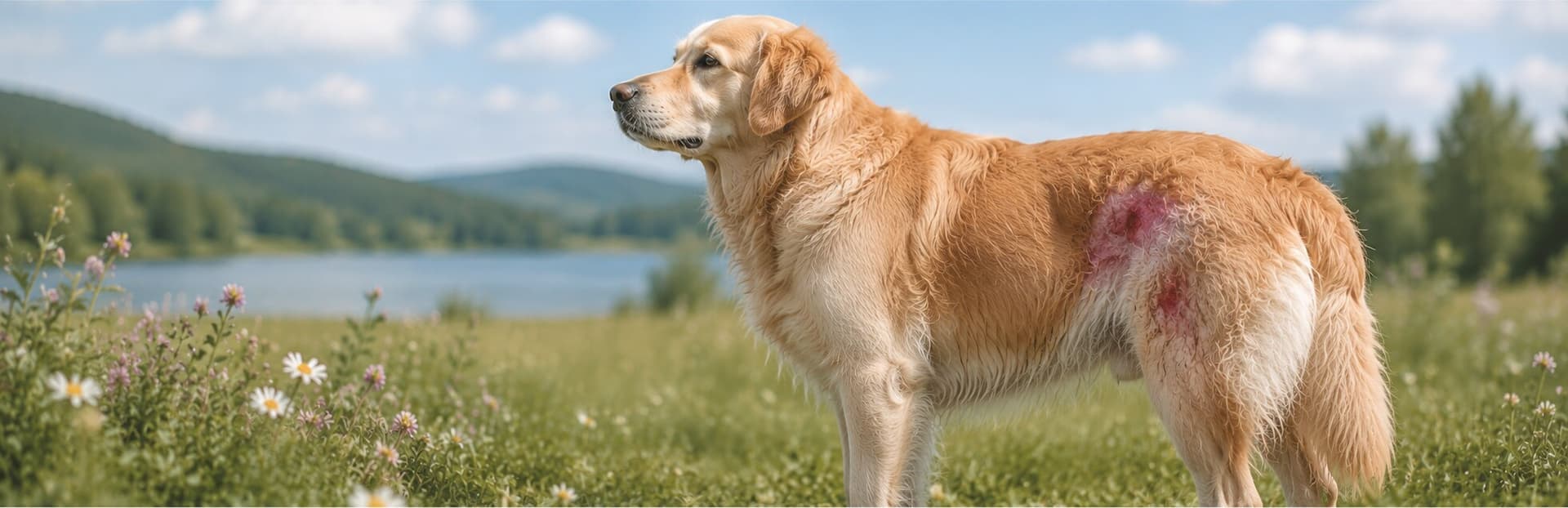
Also called acute moist dermatitis
Hot Spots, Rashes & Skin Irritations
One of the most common skin complaints in dogs and cats — a red, moist, fast-spreading patch that can appear seemingly out of nowhere. Here's what it actually is, what tends to trigger it, and the botanical routine we recommend to help it settle.
What It Is
An itch that feeds itself
A “hot spot” — properly acute moist dermatitis — is a patch of irritated, inflamed skin that a dog or cat can't stop licking. The licking traps moisture. The moisture invites bacteria. The bacteria worsen the irritation. And so the cycle deepens, usually within 24 to 48 hours, into a distinctive red, warm, damp, smelly patch.
Hot spots can appear anywhere — the rump, the hind leg, the neck, the flank — and are most common in breeds with dense or double coats where moisture is slow to escape. Breaking the itch-lick-moisture cycle early is the whole game.
What To Watch For
Signs of a Hot Spot
Hot spots usually announce themselves. If you see a few of these together, act quickly — the first 24 hours matter.
A Red, Inflamed Patch
The signature look — an angry-red, moist, roughly circular area of skin, often surrounded by damp fur.
Constant Licking or Biting
Your dog can't leave it alone. The area often gets worse each time they groom it, which is what makes hot spots so fast-spreading.
Hair Loss Around the Site
Fur pulls out from the licking and rubbing, sometimes leaving a bald ring around the patch.
Warm to the Touch
The name isn't accidental — a hot spot really does feel warm compared to surrounding skin, from the local inflammation.
Odour
Moisture + inflamed skin + normal skin bacteria = a distinctive smell that often shows up within 24–48 hours.
Fast Spread
Left alone, a small nickel-sized irritation can double or triple in size in a day. Speed matters.
Why They Happen
What Tends to Trigger Hot Spots
Hot spots are almost always started by something. Identifying the trigger is the difference between one-and-done and a recurring problem.
Environmental Allergens
Grass, pollens and household triggers are behind a large share of hot spots. Some dogs are exquisitely sensitive to plain lawn grass.
Fleas & Parasites
A single flea bite can be enough to set off an allergic dog's skin. Mites, ticks and their bites work the same way.
Moisture Trapped in the Coat
A dense or matted coat holds water against the skin. Given long enough, normal surface bacteria multiply into an infection.
Small Skin Breaks
Clipper nicks, scratches from play, minor grazes — anywhere the skin's defence is briefly down is a possible starting point.
Know When to Escalate
When to See a Vet
Most hot spots settle at home with gentle botanical care in the first week. These are the situations where a vet visit stops being optional.
Larger Than a €2 Coin
Hot spots this size or bigger usually mean the infection has moved deeper than a topical alone can reach.
Spreading Fast
If the patch has visibly doubled in size within 24 hours despite gentle care, it's escalating faster than home treatment can catch up.
Systemic Signs
Off their food, lethargic, running a fever, or the skin is hot far beyond the visible edges — call the vet the same day.
Recurring in the Same Spot
The third time in a year is not the third time — it's a pattern. Something (allergy, flea sensitivity, coat management) is worth investigating properly.
When in doubt, call. Vets would rather see a hot spot early than after it's turned into something deeper.

The Dermagic Approach
Gentle botanical care that breaks the cycle
A hot spot doesn't need aggression, it needs interruption. Break the itch-lick loop, cool and calm the inflamed skin, and give the surface a chance to close. That's what the Dermagic system is designed to do — organic aloe, neem and essential oils in a topical routine you can start the moment you spot the redness.
For most healthy dogs and cats a hot spot on its own settles within three to four weeks of consistent care and a cone. The four-step system that follows works around Hot Spot Salve — the product Adelia formulated specifically for this concern — and adds the cleanse, the surrounding rescue, and the finishing crème that make sure it stays gone.
What to Expect
What Recovery Looks Like
Most healthy dogs and cats settle a hot spot in three to four weeks with consistent botanical care and the licking under control.
Days 1–3
Cool, Clean, Cover
The first 72 hours are about stopping the spread. Trim the fur around the spot (blunt-ended scissors, not clippers), clean the area gently, apply a topical, and use a cone or a soft t-shirt so your dog can't get back to it.
Week 1
The Anger Goes Out
With a botanical topical applied consistently, the redness usually starts to soften inside the first week. The area feels less warm. The licking urge — if you can prevent it — begins to fade.
Week 2
Skin Surface Settles
The moist stage transitions into a drier scab that shouldn't be picked. Any smell has usually gone. Continued gentle care keeps it moving forward.
Week 3–4
New Fur Returns
The last of the crust comes off and fine new fur appears in the bare area. Most hot spots on healthy skin are fully resolved in this window with consistent care.
What We Recommend
The Dermagic Four-Step System
Hot Spot Salve is the hero product for the affected area itself — but a full four-step routine settles the surrounding skin, prevents flare-ups, and speeds the finish.
Read the full four-step systemStep 01 · Cleanse
Peppermint & Tea Tree Pack
A gentle, pH-balanced bath the day before you start topical treatment clears build-up and gives the botanicals that follow the best possible start.
View productStep 02 · Rescue
Skin Rescue Lotion
The workhorse for the surrounding inflamed skin — organic aloe, neem and essential oils applied twice daily around the affected area.
View productStep 03 · Target
Hot Spot Salve
The Dermagic product designed for exactly this concern. A dab directly on the hot spot itself once or twice daily until the area has settled.
View productStep 04 · Restore
Cell Restoration Creme
Once the area is dry and healing, this rich shea and coconut finisher softens the new skin and coat coming through.
View product
A Gentle Reminder
What We Suggest — And What To Avoid
Do
- Trim, don't shave, the fur around the site
- Apply the topical consistently, twice daily
- Cone, t-shirt or bandage until the area is closed and dry
- Track the size — a photo every 48 hours helps you see progress
Avoid
- Ignoring it — hot spots grow fast if left alone
- Cortisone or steroid creams as a first response — they can mask, not resolve
- Human antiseptics (hydrogen peroxide, alcohol, iodine) directly on the wound
- Letting your dog keep licking — recovery slows to a crawl
Common Questions
Questions Owners Ask
Is a hot spot painful for my dog?
Yes — hot spots are itchy and often genuinely sore. The licking and biting isn't naughty behaviour; your dog is trying to self-soothe.
Should I clip the fur around the hot spot?
Yes, if you can do it calmly. Trimming the fur around the site with blunt-ended scissors (not clippers, which can nick the skin) lets air reach the area and any topical products actually work.
Will a cone actually help?
Enormously. Hot spots are self-perpetuating — dogs make them worse each time they lick. A cone or a snug t-shirt for the length of the recovery is often the single biggest factor.
When should I see the vet?
If a hot spot is bigger than a €2 coin, spreading fast, has pus, is warm-hot to the touch far beyond its edges, or your dog is off their food, book a vet visit. Deep infections and secondary problems can develop quickly.
Can hot spots come back?
Yes, especially if the underlying trigger (allergy, flea sensitivity, grooming schedule, coat moisture) isn't identified. If your dog gets recurrent hot spots, it's worth investigating the pattern with your vet.
Can I use Dermagic on my cat?
Yes — the Dermagic system is formulated for both dogs and cats when used as directed.
Break the Cycle Early
Hot spots are one of the fastest-moving skin conditions you'll deal with — and one of the most responsive to prompt, gentle botanical care. Break the itch-lick cycle in the first 24 hours and most cases settle without a vet trip.